

Your delivery van's parked sideways on the side of the Princes Freeway with a caved-in driver's door. It's Tuesday morning. You've got jobs booked through to Friday. The panel beater you've used for the family Camry takes one look at the photos you send through and says they don't really do commercials.
This is the call we get most often from tradies, fleet managers and small business owners across Melbourne's west. Truck and commercial smash repair is genuinely different from car repair, and most workshops aren't set up for it. Here's what changes when the vehicle off the road is also the one earning you money.
Why truck smash repair isn't just car repair on a bigger scale
| What you're hearing or feeling | What it usually means | How urgent |
|---|---|---|
| High-pitched squeal at low speed | Pad wear indicators or glazed pads | Book this week |
| Metallic grinding under braking | Pads worn through to the metal, rotor damage starting | Book today |
| Soft or spongy pedal | Air in the lines, fluid leak, or master cylinder issue | Book today |
| Pedal sinks slowly to the floor | Likely a brake fluid leak or master cylinder failure | Stop driving and call |
| Vibration through the pedal at highway speed | Warped rotors or uneven pad deposits | Book this week |
| Vibration through the steering at highway speed | Warped front rotors or sticking calliper | Book this week |
| Car pulls to one side under braking | Sticking calliper, uneven pad wear, contaminated pad | Book today |
| Brake or low brake fluid warning light | Low fluid (often from worn pads) or an ABS fault | Book today |
| Burning smell after stopping | Overheated brakes, sticking calliper, or handbrake left on | Book today |
General guidance only. A diagnostic at the workshop is the only way to confirm what's happening with your brakes.
What each brake warning sign means
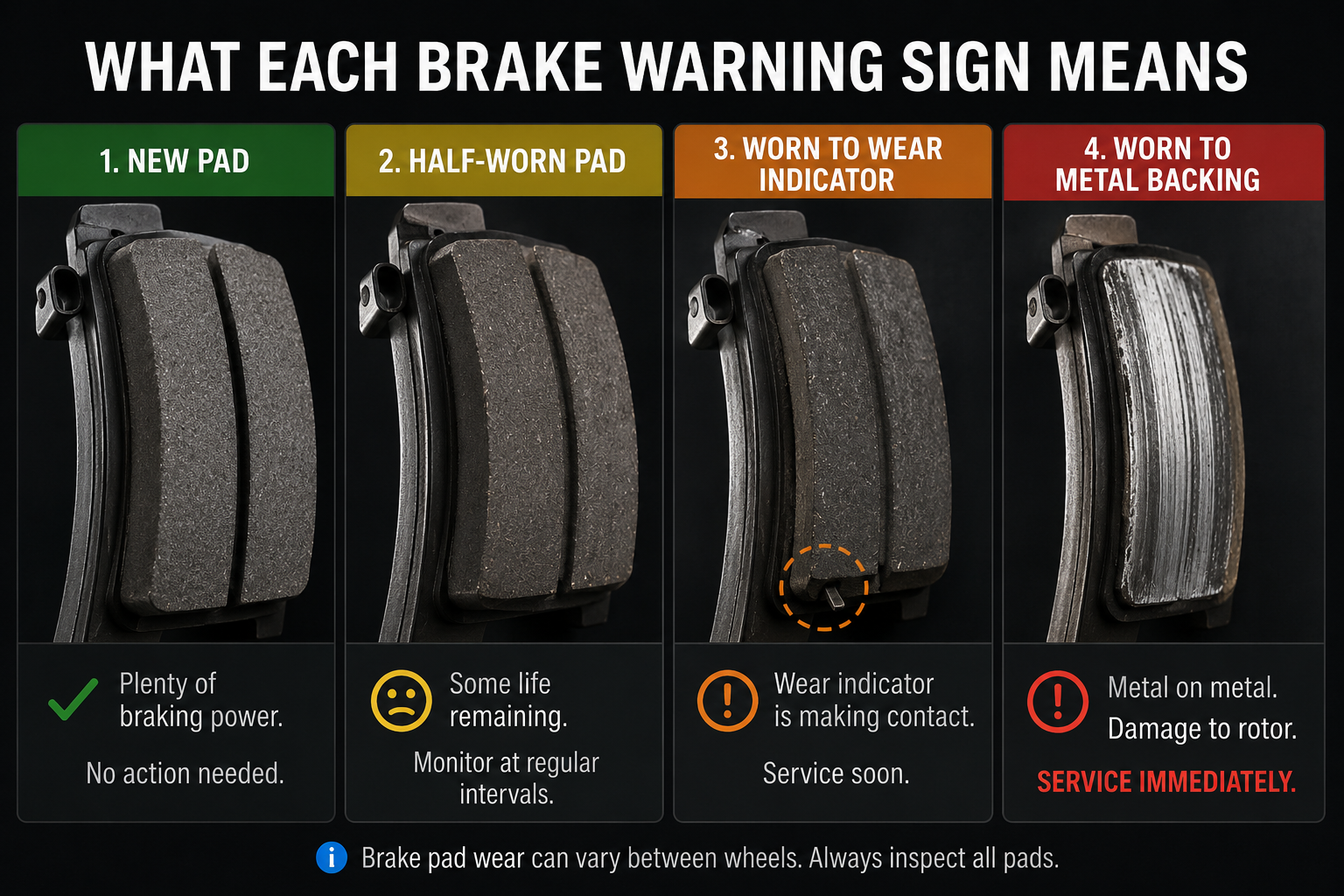
- Squealing or screeching at low speed. Most modern pads have a small metal tab built in called a wear indicator. When the pad wears down to around 3 mm, the tab touches the rotor and creates a squeal whenever you brake. Glazed pads (where the surface has hardened from repeated overheating) make a similar noise. The workshop will measure the pads and tell you how much life is left.
- Metallic grinding under braking. Grinding usually means the pads have worn through the friction material and the metal backing plate is scraping the rotor. Every stop from here damages the rotor surface, turning a pad-only job into pads plus rotors. The car needs to come in within a day or two.
- A soft or spongy pedal. A healthy brake pedal feels firm under your foot. If it sinks further than it should, or feels squishy, the common causes are air in the brake lines, a fluid leak, or a failing master cylinder. A pedal that slowly sinks to the floor while you're sitting at a red light points to internal master cylinder failure. Book it in before the next big drive.
- Vibration through the pedal or steering. Vibration at highway speed that worsens with harder braking usually points to warped rotors or uneven pad material deposited across the rotor surface. Vibration through the pedal means both front rotors are likely involved. Vibration through the steering wheel means front-end braking force is unbalanced. Resurfacing works in some cases; often replacement is the cleaner fix.
- Pulling to one side under braking. A car that veers left or right under braking has uneven force across the front axle. The common causes are a sticking calliper on one side, uneven pad wear, or a contaminated pad with oil or brake fluid on the friction surface. Don't ignore this one. A pull under heavy braking can put the car into the next lane.
- A brake warning light on the dash. The brake light usually means one of three things: low brake fluid, the handbrake is engaged, or the system has detected an ABS fault. Low fluid is often a knock-on effect of worn pads, since the level drops as the calliper pistons extend further to reach them. On many European cars, a separate sensor in the pad triggers a dashboard warning when it's time for new pads.
How long do brake pads and rotors last
Brake pad life depends more on how you drive than on the brand of pad fitted. The Princes Freeway commute from Truganina to the city in peak traffic, with constant stop-start braking, wears front pads faster than the same kilometres on country roads. Towing, hilly routes and aggressive braking all chew pads faster too.
As a rough guide for front pads:
- Heavy city stop-start commutes: 30,000 to 50,000 km
- Mixed suburban and freeway: 50,000 to 70,000 km
- Mostly highway and country roads: 70,000 to 90,000 km
Rear pads usually last two to one over fronts because the front brakes do roughly 70 percent of the stopping work. Rotors typically last through two sets of pads (60,000 to 100,000 km) when pads are replaced before they reach the metal backing.
Pads only, or pads and rotors?
The decision between pads only and pads with rotors comes down to rotor condition. Every brake rotor has a minimum thickness stamped on its outer face by the manufacturer. Below that thickness, the rotor can't shed the heat from hard braking safely, and it has to be replaced. That isn't a workshop preference, it's a manufacturer specification.
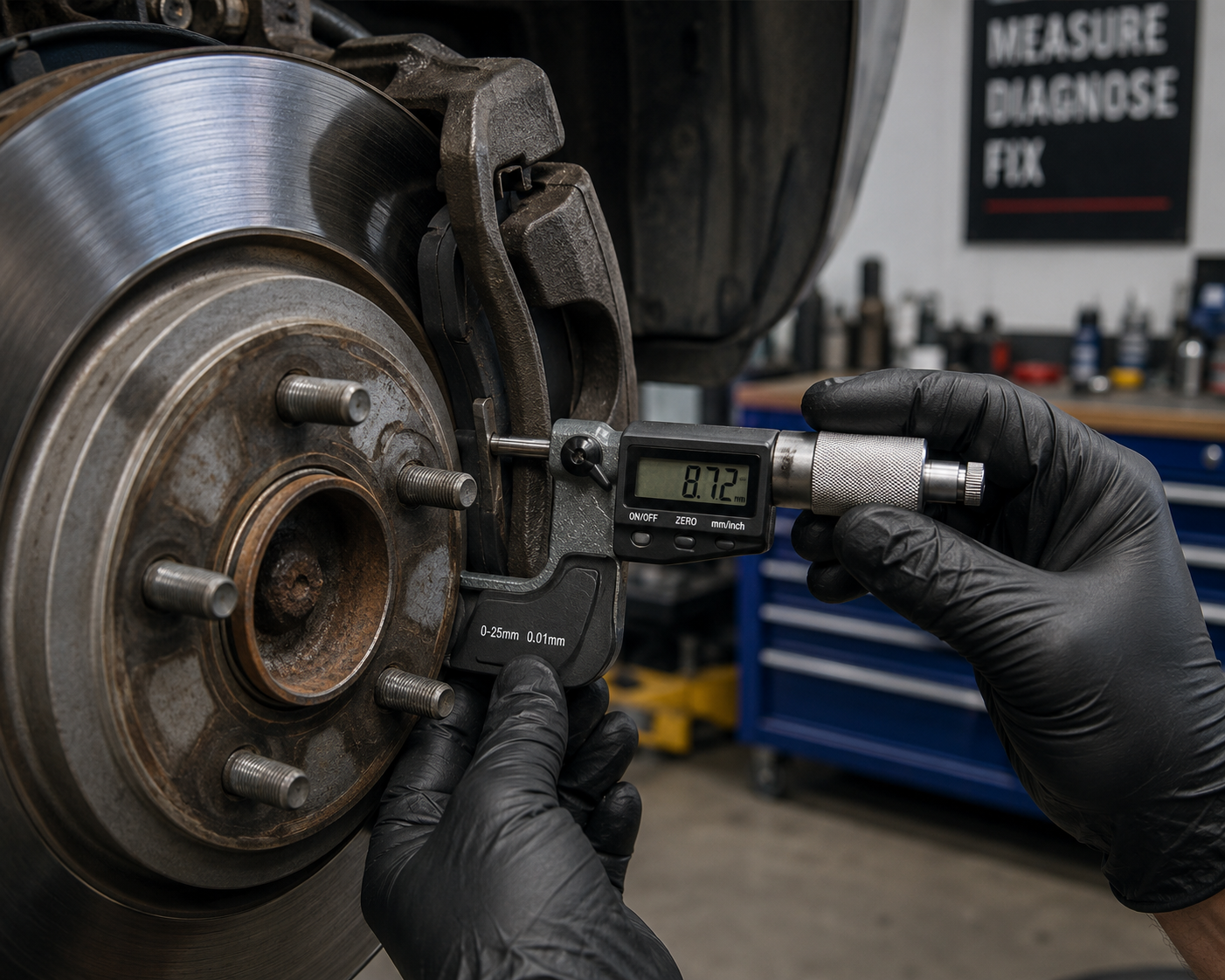
The other factor is the rotor surface. If it's smooth and within the thickness spec, new pads will bed in cleanly. If the rotor is deeply scored, glazed, or has heavy wear ridges, fitting new pads to it shortens their life and produces noisy, juddery braking. The workshop measures the rotor with a micrometer and recommends accordingly.
Approximate costs in Melbourne for a standard passenger car:
- Front pads only: $200 to $450
- Front pads and rotors: $500 to $800
- All four pads: $400 to $700
- All four pads and rotors: $1,200 to $2,000
European, performance and larger SUV vehicles sit above these ranges. The workshop should give a written quote before any work starts.
What a brake inspection covers
A brake inspection is the cleanest way to find out what your car needs. The mechanic measures pad thickness against the manufacturer minimum, measures rotor thickness and checks the surface for scoring or warping, checks the callipers for sticking pistons and seized slide pins, checks the brake fluid level and condition, looks at the flexible hoses for cracking or bulging, and tests the handbrake travel. The whole job takes around 20 minutes.
Many workshops include a brake check inside a general service, or run a standalone brake inspection at low or no cost. If the car is already showing one of the symptoms in the table above, there's no reason to wait.
Common questions about brake repairs
Grinding means the pads have worn through to the metal backing plate, and every kilometre damages the rotor surface further. The car will still stop, but stopping distances are longer, and what was a pad-only job has likely become pads plus rotors. Drive straight to the workshop, not via the long way home.
A front pad replacement on a standard passenger car generally runs $200 to $450 including parts and labour. Adding front rotors takes it to $500 to $800. A full job at all four corners with pads and rotors sits between $1,200 and $2,000 for most cars, more for European vehicles and larger SUVs. A standalone brake inspection is generally free or low-cost.
No. The front pads do roughly 70 percent of the braking work and wear faster than the rears, often by two to one. It's common to replace front pads twice in the life of one set of rear pads. Within the same axle, pads should wear evenly. If one side is noticeably more worn than the other, that points to a sticking calliper.
Rotors are replaced in axle pairs, not all four at once unless all four have reached minimum thickness. If the fronts have worn out and the rears are still well within spec, fitting new rears just adds cost without a safety benefit.
A brake service is the routine job: inspect the system, replace pads if needed, check rotors, top up fluid. A brake repair fixes something that's gone wrong, like a sticking calliper, a fluid leak, a damaged hose, or brake damage from a kerb hit or accident. At Street Elite Bodyworks, the mechanical brake work and any panel damage from the same incident can be handled at one workshop.
Book a brake inspection
If the brakes have started squealing on the Princes Freeway off-ramp, or the pedal feels softer than it did a month ago, book a brake inspection at Street Elite Bodyworks in Truganina. The mechanic will measure the pads and rotors, walk you through what the car needs, and give you a written quote before any work starts. Drivers come in from Truganina, Tarneit and Williams Landing for the same reason: catching the problem at the inspection stage costs less than waiting for something to fail. And if the brake fault traces back to a recent kerb hit or low-speed bump, the same workshop can sort out the panel side too.