

A van sitting in a repair shop car park is a van that isn’t earning. When a work vehicle is off the road, you keep paying for it while it brings in nothing.
So it’s a fair question to ask. Can one workshop keep your fleet serviced and repair it after a knock, instead of you running between three different shops?
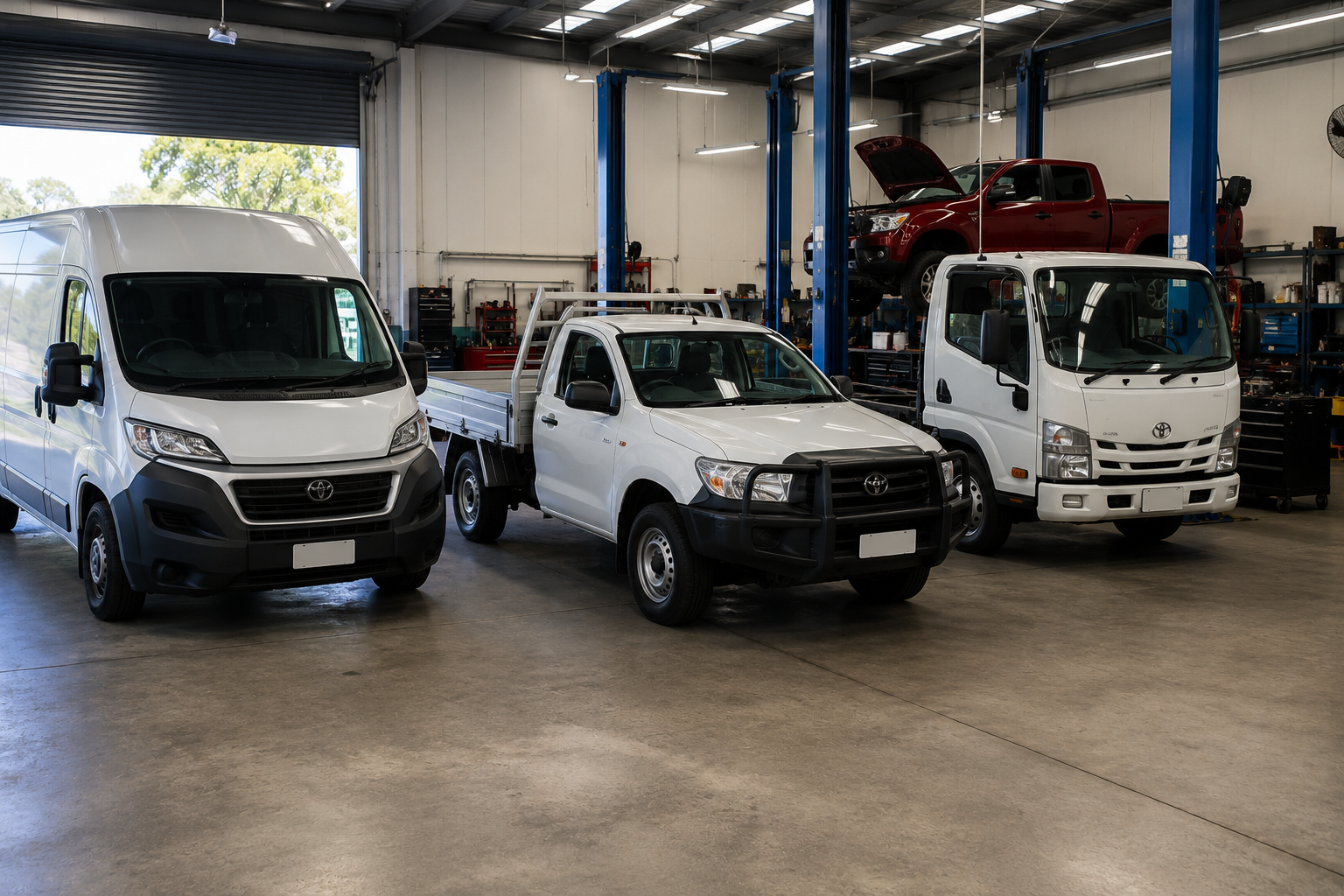
For most light commercial fleets, yes. One workshop that does both mechanical servicing and panel repair can cover the bulk of your fleet maintenance: servicing your utes, vans and light trucks, and fixing them after a bump, all from one place. That means one booking, one point of contact, and one service history per vehicle. The honest limit is specialist warranty work and some heavy-truck jobs, so a single workshop handles most of a fleet’s needs, not every last one.
Here’s how that works in practice, and where it stops.
The real cost of a vehicle off the road
A vehicle off the road costs you twice. You lose the work it would have done, and you still carry its running costs while it sits idle.
There’s often a third cost too. You might pay a driver who has no vehicle to drive, hire a replacement, or turn down a job you can’t cover. None of that shows up on the repair invoice, but all of it comes out of your week.
Now spread the jobs across separate shops. The service goes to a mechanic. The dented panel goes to a smash repairer. The worn tyres go somewhere else again. Each one is a separate drop-off, a separate pick-up, and a separate gap in your roster.
For one car, that’s an annoyance. For a fleet, it stacks up. Three vehicles each losing a day here and a day there becomes real lost revenue across a month.
The case for one-stop fleet maintenance
The pull of one workshop is simple. The same place that services your fleet can also fix it when something gets damaged.
Under one roof, a hybrid workshop can handle:
- Scheduled servicing. Logbook services (the maker’s set service schedule) that keep each vehicle running and its warranty intact.
- Brakes, tyres and suspension. The wear items that go first on hard-working vehicles doing stop-start delivery runs.
- Panel and accident repair. Kerb scrapes, loading-bay dents and crash damage, put right and repainted to match.
- One record per vehicle. Every service and repair logged in the same place, for the same van, across its whole life.
Here’s how the two approaches compare.
| Spread across separate shops | One hybrid workshop | |
|---|---|---|
| Bookings | Three or more to chase | One, one contact |
| Drop-offs | Several trips across the week | One trip |
| Records | Split across different invoices | One history per vehicle |
| Downtime | Stacks up with each handoff | Bundled into fewer visits |
| Damage found early | Falls through the gaps | Spotted at the next service |
That last row matters more than it looks. When the same workshop services and repairs a vehicle, a cracked mount or a leaking shock gets picked up at the service, before it turns into a breakdown on a run.
Where one workshop genuinely saves you time
The clearest saving is bundling. If a van is already booked in for its logbook service, a small panel fix or a tyre change can be done in the same visit. One drop-off instead of three.
You also get one team that knows the vehicle. They’ve seen its service history and its repair history, so they’re not starting cold each time. Small faults get chased before they strand a driver mid-run.
For a trade or freight operator, that means fewer phone calls, fewer holes in the roster, and fewer vehicles you’re chasing across town.
Where it doesn’t
Being straight about the limits matters, because overselling this helps no one.
Some jobs still belong elsewhere. If a vehicle is under manufacturer warranty and a covered part fails, that repair may need to go through the maker’s authorised agent to be paid for. A good workshop tells you when that’s the case instead of taking the job.
The largest trucks can also sit outside a general workshop’s scope. Most hybrid workshops cover light commercials and rigid trucks, but not the biggest articulated rigs. If your fleet runs prime movers and semi-trailers, some of that work belongs with a heavy-vehicle specialist.
So one workshop is the right base for most fleets, with a short list of exceptions you plan around rather than pretend away.
Keeping the fleet compliant
Compliance is where steady servicing pays off, and it works differently depending on vehicle size.
In Victoria, a light vehicle (under 4.5 tonnes gross vehicle mass, the loaded weight stamped on the compliance plate) doesn’t need a routine annual roadworthy. A certificate of roadworthiness is generally only required when you sell or re-register the vehicle, or to clear a defect notice.
That sounds like less to track, but it puts the discipline on you. No yearly inspection forces the issue, so a fleet only stays road-ready if someone keeps it serviced. Regular logbook services, brake checks and tyre checks are what keep each vehicle safe to drive and able to pass a roadworthy when one is needed.
If any vehicle tops 4.5 tonnes GVM, the rules change. Heavier vehicles fall under the Heavy Vehicle National Law, run by the National Heavy Vehicle Regulator. Operators there have a duty to keep the vehicle roadworthy, backed by maintenance records. Some trades don’t realise a larger cab-chassis or tipper pushes them into that bracket, so it pays to check the GVM on each plate.
One record per vehicle, and why it matters
A single service history per vehicle is worth more than it looks. It helps at three moments in particular.
For warranty, an unbroken logbook record proves the servicing was kept up. If a maker questions a warranty claim, that history is your evidence the vehicle was looked after.
At resale, a documented history lifts what a buyer or dealer will pay. A van with a clean, complete service and repair record is an easier sell than one with gaps and mystery work.
At claim time, the same records help an assessor. If a vehicle is damaged and you lodge an insurance claim, a clear maintenance and repair history makes the assessment smoother. Your policy document, the product disclosure statement, still decides what’s covered, but good records support your side.
Talk to us about your fleet
Plenty of freight and trade operators run out of Truganina and Melbourne’s west with mixed fleets of utes, vans and light trucks. For those businesses, the case for one workshop is strongest. The vehicles are always working, so every day off the road is a day of lost work.
If that’s your setup, it’s worth putting a servicing and repair arrangement in place rather than booking each job ad hoc. One workshop that services the fleet, handles the truck repairs and panel damage, and keeps the records means a vehicle gets back to earning sooner.
Talk to us about a fleet servicing and repair plan for your vehicles, and we’ll work out what fits how your fleet runs.