

When a truck is off the road, it isn't just a vehicle sitting in a workshop. It's a run not done, a delivery pushed back, a driver with nothing to drive. So when a damaged light commercial or rigid truck comes in, the first question is usually the same one: how fast can I get it back? Part of the honest answer is that truck smash repairs follow a different process to car panel work, and knowing why helps you plan around the downtime instead of guessing at it.
The short version: a truck is built differently, weighs more, and carries bigger panels than a car. That changes how the damage is measured, how the structure is straightened, how much surface has to be painted, and what needs checking underneath before the truck goes back to work. Each of those steps needs different gear, and often more time.
What makes truck smash repairs different?
Most of the difference comes down to how a truck is put together compared with a car. Here's a quick side-by-side before we get into each part.
| What changes | Family car | Truck |
|---|---|---|
| Structure | One welded shell (monocoque) | Separate ladder chassis, body on top |
| Panels | Smaller, curved, thin steel | Larger, flatter, heavier steel or alloy |
| Paint | Small sections at a time | Big flat areas, often with signage |
| Running gear | Light axles and suspension | Heavy axles, bigger brakes and suspension |
The chassis: a ladder frame, not a car's shell
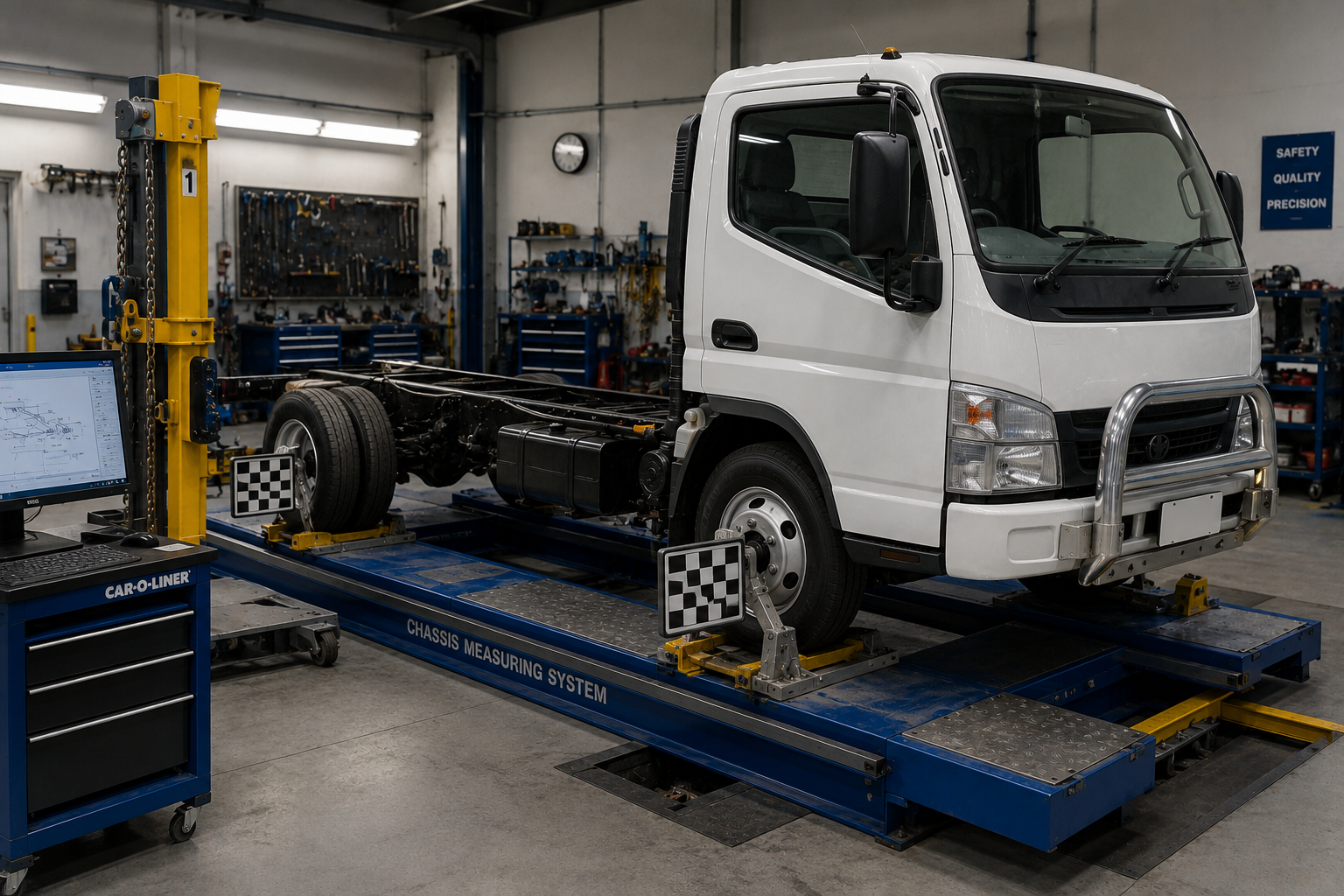
Most cars are built as a monocoque, which means the body and the frame are one welded shell that shares the load. Most trucks, and a lot of work utes and cab-chassis vans, are built body-on-frame instead. They sit on a separate ladder chassis: two long steel rails joined by cross-members, a bit like a ladder lying flat, with the cab and tray or body bolted on top.
This changes how a hit travels through the vehicle. On a car, a front corner knock often crumples in a fairly contained way, because the shell is made to fold. On a rigid truck, the force can run further back along the chassis rail than the outside damage suggests. A dent near the cab can pull the rail out of line half a metre away, and you won't spot it by eye.
So a truck repair usually starts with measuring the chassis, not just the panel. The rails are checked against the maker's figures, often on a measuring bench, and straightened back to line before any new panels go on. A chassis can also twist rather than simply bend, so a rail that measures right along its length can still sit out of square across the vehicle, which is another reason the measuring step comes first. Skip that and everything bolted to the chassis sits slightly off: the doors, the tray, the way the wheels track down the road. Getting the frame true first is what makes the rest of the repair hold.
Bigger panels, and different metal
Truck panels are a different job to car panels, and not only because they're bigger.
- Flat panels show everything. A large flat side panel or door has nowhere to hide a wave. A small ripple that would vanish in the curve of a car guard stands out on a flat truck panel, so the straightening has to be cleaner before paint goes near it.
- The metal is heavier. Truck panels are often thicker steel, and some are alloy. Thicker metal holds its shape but takes more force to move, and it reacts to heat differently, so the way you pull a dent isn't the same as on a thin car panel.
- Replacing can beat repairing. On a big flat skin, working it perfectly straight can take longer than fitting a new panel. On a truck, replacing a bolt-on panel is sometimes the cleaner, faster result, where on a car that same panel might be worth saving.
Paint and respray: a much bigger surface
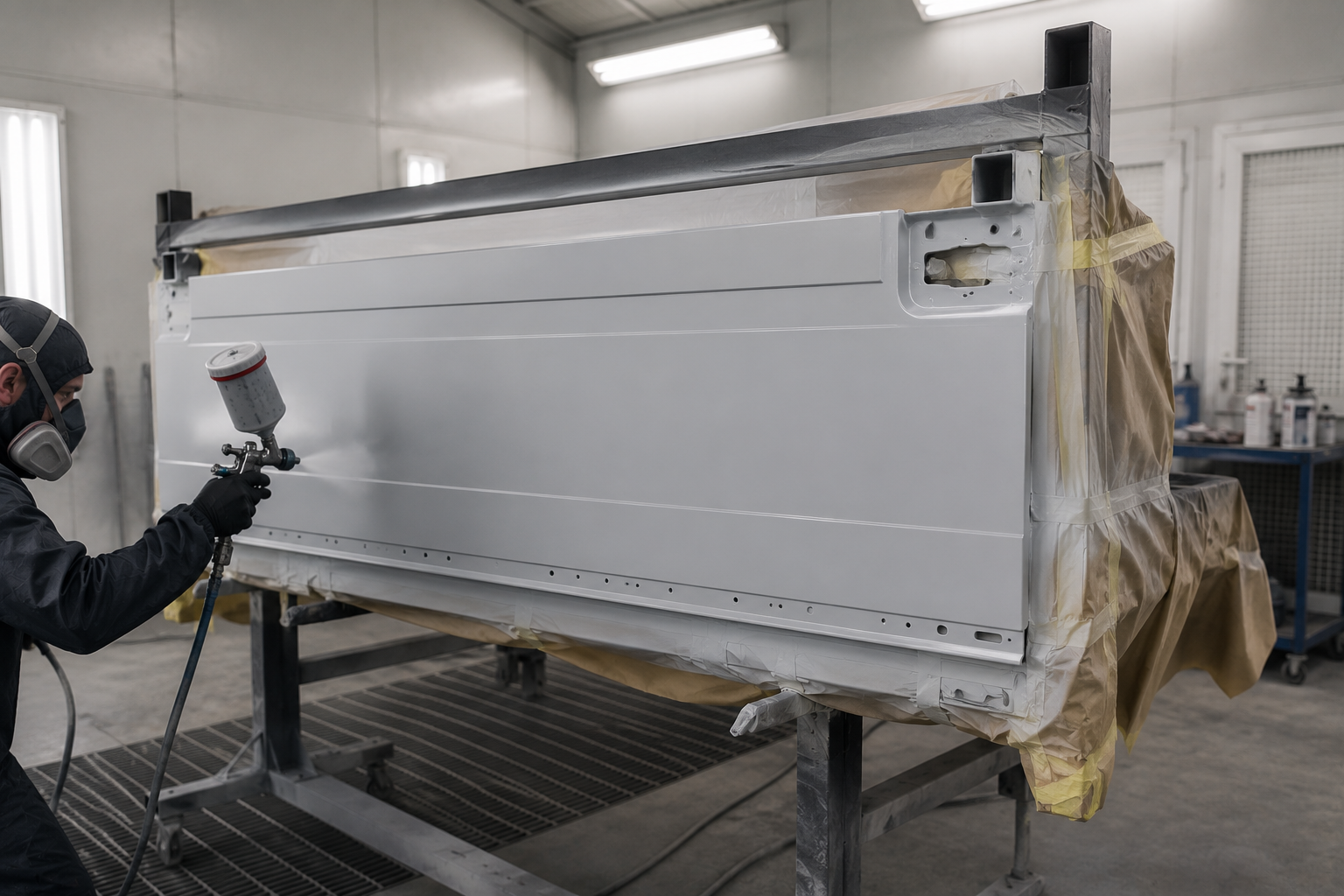
The paint stage is where truck size really shows. A car respray might blend one guard into a door. A truck has large flat areas that all have to match, and getting an even colour across that much surface is harder, not just slower.
- Matching colour across big panels. Paint reads slightly differently across a large flat area than it does on a small curved one, so matching a new panel to the rest of the body takes careful blending. On a big flat panel there is often no natural edge to hide the join, so the new colour has to be faded into the surrounding paint across a wider area than a car would need. Trucks live outside and cop a lot of sun, which fades the original colour over time, and that faded shade is what a new panel has to be matched to.
- Signage and livery add a step. Many work trucks carry a business name, logo or full wrap. If the damaged area had signage on it, that signage has to be masked around, removed and reproduced, or re-wrapped after paint. It's a separate job on top of the panel and paint work, and it's part of why a signed truck can take longer to finish than a plain one.
Wheels, axles and suspension after a hit
The parts under a truck are heavier and carry more load than a car's, so a knock that looks cosmetic can still shift something that matters. A kerb strike or a loading-bay shunt can push a wheel out of line, bend a step or bracket, or jar the suspension, even when the panel damage looks small.
On a working truck this matters more than on a family car, because the vehicle runs loaded, day after day. A wheel that points slightly off will chew through expensive truck tyres and drag on the steering. So a proper repair includes checking the running gear and the wheel alignment after the panel work, not just handing back a truck that looks straight.
This is where having the panel work and the mechanical check done in the one workshop earns its place. The structural repair and the follow-up on wheels, axles and suspension happen under one roof, so nothing slips through the gap between a panel shop and a separate mechanic.
Which trucks can be repaired here?
Not every panel shop has the room, the height or the equipment to take a truck, so it's worth knowing what fits. This workshop handles light commercial vehicles through to heavy rigid trucks.
In plain terms, that range covers:
- Light commercial vehicles: work vans, utes and small cab-chassis under 4.5 tonnes, the sort you can drive on a car licence.
- Rigid trucks over 4.5 tonnes: above that gross vehicle mass (the maker's maximum loaded weight, stamped on the compliance plate), a vehicle counts as a heavy vehicle in Australia. A rigid truck is a single fixed unit, cab and body on one chassis, with no pivoting trailer.
- Heavy rigid trucks: the larger end of that, still a single unit, just with more axles and more weight.
The line this workshop draws is at rigid trucks. A prime mover towing a semi-trailer, an articulated truck, is a different setup again. If you're not sure where your vehicle sits, the gross vehicle mass on the compliance plate is the number that settles it.
The knocks we see most around Melbourne's west
Truganina sits in the middle of a lot of freight movement, and the damage that comes through the door tends to reflect that.
- Industrial estates and loading bays. Tight yards and reversing into docks are where light commercials pick up rear and corner damage, clipped mirrors and bent steps.
- Kerbs and roundabouts. The industrial roundabouts around Truganina and Laverton, and the run to the West Gate Tunnel, catch plenty of low-speed kerb strikes that tuck a wheel out of line.
- Long days on the freeway. Trucks working the Princes Freeway and the M80 rack up the kilometres, so stone chips, scrapes and the odd merge-lane clip are just part of the job.
Getting a damaged truck back to work
A damaged truck is money sitting still, so the aim is a repair done properly the first time, back on the road without a return visit. That means measuring the chassis before touching a panel, matching paint across big flat surfaces, sorting the signage, and checking the running gear before it leaves the yard. The earlier you get a quote, while you're still working out how to cover the run, the shorter you can keep the downtime. For a quote on truck smash repairs, get in touch with Street Elite Bodyworks.